Friday, August 18, 2006

Dell Computers Burst into Flames?!


This is choice.

You know I've been on a computer jag for quite a while. From smoking, crackling computers to levitating Lenovos (keep reading this blog to figure out what the hairy-heck that one was about) to laptops that grow legs and run away -- it's getting dicey for us GOSSIPS (gadget obsessed, smugly superior, internet professionals). Now, they just catch fire.

Here's the scoop. Turns out that Dell computers equips some of their computers (about 4.1 million of 'em) with an additional, no-cost feature...a high-yield heating source, great for those chilly Midwestern winter nights. However, during these sultry summer days, it's not such a good thing.

Every evening Garland (hubby-fabulosa) and I retire upstairs to watch The Daily Show and tap out the last of our work for the night (actually, Garland's queuing-up tasks for the next day, and I'm learning something random from wikipedia -- tonight was about Cheddar, England and, yes, I need another hobby). Garland stepped away to get something from his office and, I sat there staring at his Dell computer, sitting there innocently on his side of the futon.

My brother in Hotlanta, told me that an FAA rep assured him, on a recent flight, that airplane fire retardants were sufficient to put out any computers that catch fire, particularly in the holds. His concern? That one catch fire on the tray table in back of his seat (no sense of adventure, that one).

I'm wondering why this is an issue now, particularly when, as it turns out, Dell can trace this pesky problem back to around July of 2004! For how long have they known, I wonder? The government has been on a tear about cigarette companies who, knowlingly promoted their deadly product. If they knew about the problem, it could run Dell afoul of the same laws that are plaguing cigarette manufacturers -- the RICO Act.

Thursday, August 17, 2006

Ramsey Suspect Captured, But Who Else Might We be Killing?

Just weeks after Patsy lost her life to ovarian cancer, it appears the murderer of her six year old daughter, JonBenet, may have been captured.

The JonBenet Ramsey case is an unfortunate example of negative buzz -- the kind of "where there's smoke there's fire" thinking that spreads almost as fast as the hype around "Snakes on a Plane." The public immediately seized on the peculiar nature of the pageants that JonBenet participated in with her mother, another pageant winner and lifelong pageant enthusiast. Under a cloud of suspicion, Patsy Ramsey tried to live her life, raise her son and struggle with cancer while grieving a daughter that many thought she'd killed.

Let's face it: We're a nation of gossips. And I don't mean GOSSIP -- Gadget-Obsessed Socially Superior Independent Professional...those cats who have a blackberry, a personal and work cellphone and drink pricey, branded coffee even if the coffee's free at work. Our amusements are rife with reality programs that allow us to voyeuristically eavesdrop on people and then chat, IM, blog and talk about it the next day. But the line between what's real and what' spun is getting blurrier. One story can become a runaway train with little hope of turning or slowing when new facts come to light.

A couple of years ago, a local businessman was rumored to have hit his wife. It wasn't true, as it turned out, but people were talking about it. He was shunned, asked to step down from a public accountability and his business suffered. His wife, a chick with some substance, denied the rumors and even found the person that had started it -- a little self-aggrandizing that got out of control -- but it didn't matter.

For me, when I met with him shortly after this began to heat up, I felt a little ashamed of what I'd heard, so I told him what I knew and from whom I got it. Then, I went back to my "Don't talk about that with me or I'll squeal" policy that had been so useful years before.

One of the worst things I think we do in business is assume. We do it when we network, when we prospect, when we hire. We shortcut our thinking because, many times, it works....Except when it doesn't. Now, I'm not saying never assume. What I am asserting is that assuming without assumption-testing is worst than going off half-cocked. See if you're right about your assumptions.

Our most powerful weapon against false info: the question. So, be sure you ask.

Monday, August 14, 2006

Samuel L. Jackson Called My Husband


OK, fine! So it wasn't actually Samuel L. -- it was a recording of Samuel L. that called Garland. When he gathered the voicemails on Sunday, what did he hear? "I can't stand all these %@#!$#@%#@$ snakes on this %@#!$#@%#@$ plane!"

Choice.

Now, I'm not entirely sure that this movie is my cup of tea. Yes, I enjoyed lots of slasher movies in my earlier years (Shu-shu-shu-shu-shu. Hah-hah-hah-hah-hah.*). However, I think I've grown significantly over the years.

Not really.

I had a point. Oh! The cool thing about the movie isn't the scene where a couple, trying to get into the Mile High Club buys the farm in the lave (evil laughter). It's the fact that Samuel L. solicited so much word of mouth to generate buzz for this flick. He listened to his fans and supported them, even when they suggested substantive changes to the movie. An army of fans rallied around the project, starting websites, selling t-shirts and other merchandise. They even pressured the studio to change the name of the film from Pacific Flight 121 to Snakes on a Plane, which the studio did.

This movie has achieved cult status -- and it isn't even out yet.

What does this have to do with your business?
The studio execs were surprised and Time magazine did an article on this "phenomenon." Though word of mouth is the least studied marketing method, it just happens to be the most effective...and the oldest.

There is an endless list of products that people have bought because someone else said it was the neatest thing since deep-fat fried turkey (I ate it only because I heard people raving about it --Eh!). Our customers know what they want and, for the most part, there's no amount of focus grouping or consumer psychology that will shake them once they've decided that a thing is cool.

The thing is: How to we more effectively dial-into WOM buzz? Companies are beginning to spring up to answer this question. Their magic bullet? Ask 'em. Customers will tell you what they want when we stop talking. They'll tell us what they want, how they want it, when they want it, what color they want it in and what they want you to call it.

We just need to do more listening than talking.
Like this movie, the fans decided that they "owned" the film. They were more than consumers. They were stakeholders of the highest order and they felt that their opinions counted. Luckily for them, Sam Jackson listens to fans. As he pointed out in a recent Time magazine interview, most directors only work on about a dozen films in their professional careers -- he has over 100 movies to his credit. In all that time, he's learned that his fans are smart about their entertainments and will vote with their feet if they don't get what they want.

Your customers, too, are voting every day about you and your product and services.

Have Samuel L. Jackson call a friend and tell them to see his movie...

Cheers!

* A reference to the Jason, Friday the 13th movies that dominated the 80's and 90's slash and dash movies.

Friday, August 11, 2006

LNB #018 - The 7 Deadly Sins of Marketing (Pt. 5)

Leighton Haynes, of Twin Phoenix Marketing, continues his marketing series with
Lalita, discussing the power of brand and customer sensitivity on business success. He urges

  • Not taking customer relationships for granted -- with both internal and external customers
  • Authorizing employees to take immediate action for customers with the tools needed to satisfy them, rather than passing it along to management.
  • Leading, or anticipating, customer needs -- not waiting for a complaint or a need
  • Measurement!

Leighton suggests the book, Primal Branding: Create Zealots for Your Brand, Your Company, and Your Future. Also, pick up must-read magazines Business 2.0 and Fast Company.

Contact Leighton, 202 203 7737

Duration: 27:25 File Size: 6.58 MB

Listen Now:

Thursday, August 10, 2006

Crazy -- Just Like Me!

There are a lot of places where I must be crazy. I started a business at the bottom of the Tech Bust. I'm in a marriage that I believe will last (just like the 60 or 70% of the others who've said the same thing -- right before filing for divorce). I think people in the Middle East want peace and I think there's a good alternative to fossil fuels hanging out out there.

Yup. I'm a nutter.

I play a lot of music at home, at work, in the car. Right now, I'm between songs (getting ready to turn on NPR's Ed Gordon to wind down the afternoon's work).

The song, below, is Crazy by Gnarles Barkley. He's done about 50 different versions of this song (and videos to match) -- in one, he's dressed up as Darth Vadar (the song is about being crazy). They're all good. I like the lyrics. Sounds a lot like the lives of the me and the people around me. Unsure about the world. Hopeful.

What music is playing for you right now?


Gnarls Barkley - Crazy EXCLUSIVE Slow Version LIVE!!

Lyrics to Crazy, by Gnarls Barkley

"I remember when, I remember, I remember when I lost my mind
There was something so pleasant about that place
Even your emotions had an echo and so much space
And when you're out there without care
Yeah I was out of touch
But it wasn't because I didn't know enough I just knew too much

"Does that make me Crazy
Does that make me Crazy
Possibly

"And I hope that you are having the time of your life
But think twice, that's my only advice
Come on now who do you, who do you, who do you, who do you think you are,
ha ha ha bless your soul
you really think you're in control well

"I think you're Crazy
I think you're Crazy
Just like me

"My heroes had the heart to lose their lives out on the limb
All I remember is thinking I want to be like them.
Ever since I was little, ever since I was little It looked like fun
And there's no coincidence I've come
And I can die when I'm done

"But Maybe I'm Crazy
Maybe you're Crazy
Maybe we're Crazy
Probably"

Thursday, August 03, 2006

Mean People are Made to Pay!

Earlier I blogged about workplace bullying and mobbing (Mean People Suck!), a prevalent system of mistreatment that amounts to psychological abuse. This mistreatment can include exclusion from workplace information and resource networks, humiliation, gossip and rumoring (which has destroyed personal, as well as professional, relationships), threats and intimidation. It can be caused by one person acting alone or by a group, or mob. Bullying and mobbing steal productivity, cause rampant turnover and create a relatively dismal work environment. In the extreme, bullying is a precursor to workplace violence.

Still, companies see it happening and do very little of any substance to make it stop. Some attempts are half-hearted, leading to more entrenched behavior. Now, companies who don’t effectively settle these claims in their HR departments are settling them in the court systems.

The British courts have just awarded a former female employee of Deutsche Bank $1.5 million in what is the largest award ever for workplace bullying. She claimed that she was subjected to "offensive, abusive, intimidating, denigrating, bullying, humiliating, patronizing, infantile and insulting words and behavior" – that she was ignored and excluded, her authority undermined and, as a result, found herself increasingly stressed-out, to the point of illness. Beyond catty, the Deutsche Bank "Gang of Four" (four other female staffers) moved quickly from the petty and catty to derisive, relentless personal and professional commentary and attacks on her competence and humanity. They didn't stop, even when she had been admitted to the hospital on a suicide watch.

Maybe we’ll start getting point: Mean people really do suck…and now they’re being made to really pay.

Read "Mean People Suck" or the article on YahooNews!

Wednesday, August 02, 2006

I Want One...Gimme!

As I mentioned before, I'm the short, Black Inspector Gadget. I've got it bad. I've got a gizmo for everything. By the by, the new breadmaker is in (the other one...melted). My husband (who has a fresh-baked bread "problem") is rolling in fresh, steamy bread (weird metaphor, to be sure) and I can send a loaf to everybody in Congress with more leftover.

My Kyocera 7135 smartphone, a lovely and dependable little gizmo is getting long in the tooth. It's 2 1/2 years old, which in high-tek years, is 175! While my heart is heavy, I'm planning for its replacement. I looked at the usual suspects: Treo 650/700 and the Crackberry, which (is it just me?) is ugly and a little too wide for my girl-sized paws.

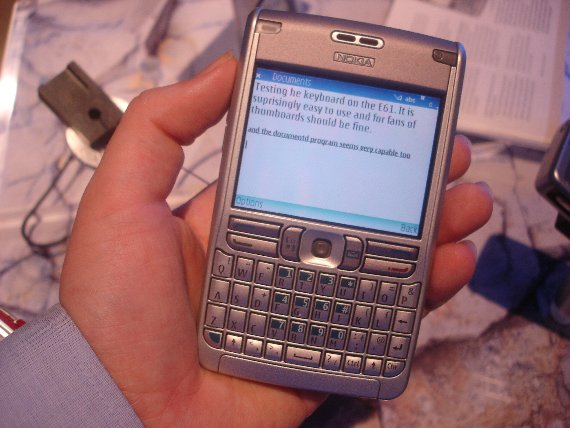
On my radar screen is the Nokia E61. It comes with Bluetooth and can use VOIP over Wi-Fi. No camera (yay), which I just don't need (I'm counting on using Garland's -- which is why...um, I got it for him last Christmas).

I'm still looking. But this does feel like petting trusty old Fifi on the head, while plotting for her replacement.

Monday, July 31, 2006

Off-Site and Out of Our Minds!

I can think of some pretty horrible things a boss could say to his or her employees: "We're downsizing and, although we appreciate your contributions".... "We've been bought out by the Lithuanians and, you're really going to think this is funny, but they've got this language requirement"...."We're instituting office sharing and you get Tuesdays and Thursdays".... "We think it might be SARS, but we've been assured that our new Ionic Breeze air cleaners will take care of it"...

Nothing, however strikes eye rolling and sighs of disgust as "Everybody. We're going on an off-site."

My last JFSEWB (job for someone else with benefits) was off-site-happy. We were lousy with "great ideas" to get away to think things over. We had the obligatory ropes course avec trust fall. Of course. We also had a strange gathering of managers with a Junguan analyst where we were treated to massage (I'm not kidding) and required to draft personal mission statements after walking out into the wilderness (of Oconomowoc, Wisconsin) until we found a place that "called to us." I"ve been camping and skiing. I've seen talking sticks (you can only speak while you're holding it -- a practical joke from our Native American brethren and sistren, to be sure) and colored hats, pebbles with adjectives on them (we were to speak from this adjective for the entire weekend) and a whole host of other trite attempts to be productive with forced togetherness.

When my clients ask me about off-sites, I sigh deeply and, trying valiantly to keep my opinions to myself (I fail here), I ask them why they think this would be a productive use of their time. It must be the tone of voice, coupled with the fact that my clients are superiorly clever, intuitive people (down to the last man and woman). They pause and contemplate, sensing their coach ready to pounce, then offer: "Because we can get a lot more done out of the office?"

Good answer. But, is it true? Consultants who study the effectiveness of training and planning interactions offer that off-sites, in the main, are only about 10% effective, wasting a lot of time with games and filler, while workers back at the office become increasingly incensed at having to hold down the fort. Companies with strained or superficial workplace relationships use off-sites in an attempt to cement relationships and wind up spending more time at this than in planning, brainstorming and focus-grouping (they try to wedge it in anyway).

When I work with my clients, they find that they need much less time in an off-site than they thought. I ask them to consider using long lunches to work on one problem at a time, rather than to try to get several things done at once. This way, they can build their off-site skills.

Questions to be answered can be:

  • What are our commitments? This could be the business goal or strategy we're involved with right now on this project? If we're doing strategic planning, this could be the creation of Mission (chief aim), Vision (the future for our business that provides us with a context from which to operate) and Values (what are we commited to not leaving out)
  • Where do we say we need to be on this project? With the company?
  • Are we there?
  • Why or why not? Is there something missing, the presence of which would make a difference?
  • If we don't know, how will we find out?
  • Relationship managemet: Whether we win or lose, does everyone feel valued and cared for? Blamed and deflated? What do you need (to re-energize yourselves)?
  • What possible actions can we take to get there?
  • How will be pick an action to develop and implement?
  • What are our next steps?


I think effective off-sites are cultural in a business. Meaning, that if a company hosts them frequently, tied to business strategy, and the results of the off-site can be seen in the organization, they make a difference.

Chime in: What are your best and worst off-site stories. Do share!

Sunday, July 30, 2006

Apple of Death

I'm hanging with Garland at a bookstore. A perfect way to wind down a weekend. I found a great magazine, Mental Floss that aims to challenge our thinking. In it, they explain that eating apple and apricot seeds - something momma told us not to do will actually kill you.

I wonder what other tidbits of mother-wit we've discounted....that turn out to be true?

Friday, July 28, 2006

LNB #017 - Create Your Kitchen Cabinet (Advisory Boards)

Business advisory boards are tools for furthering your business interests, increasing your networks, generating new ideas and advancing projects -- all of this without the formal responsibilities of a Board of Directors.

WHAT DO YOU NEED TO KNOW?

  • Your business and personal goals

  • Who can best help you

  • What do you need them to do

  • How you will reward them

  • How to work with them

There's more information in the White Paper. Visit www.totalteamsolutions.com and follow th e link to E-Books/White Papers for more.

Duration: 33 minutes, 42 seconds File Size: 8.09 MB

Listen Now:

Saturday, July 22, 2006

Um, My President Just Felt Up the German Chancellor.


I'm going to send in a proposal to do sexual harassment training for the White House. I'll keep you posted.

Aside from the fact that this is surprising and a little sad, it brings home the fact that harassment and sexual harassment have so fallen off the radar that even the President can find himself touching inappropriately.

Question for you is: do you know what constitutes the kind of speech and touches that can get your company dropped into the soup? Having done this kind of training and coaching for a number of years, I'll bet the answer is "No."

Friday, July 21, 2006

LNB #016 - Are Incubators Hatching Sound Businesses?

Business incubators were started 40 years ago in Batavia, New York to address common concerns – that first-time entrepreneurs with good ideas weren’t getting the funding, resources and support they needed to succeed and great business ideas were being lost. They address issues of expertise, resources, and social capital with

  • Resources: supplying printing, clerical support, internet and telephone services as well as funding,
  • Expertise: with business consultants and mentors who can help draft and review business, marketing and operations strategies and plan and
  • Social capital: by offering networking opportunities and introductions to key business allies.

They are designed for 2-5 years of participation and the incubators charge either a monthly fee or a percentage of ownership (many times in the range of 20 – 50%).

Issues
There’s very little research and scant results to show the effectiveness of incubators. Few begin their incubator-incubatee relationship with measures, goals and timetables for success.

Conflict of interest when incubators are pushing decisions that support their investment but may not be good for the business’ hopes for long-term growth. Many incubators do not utilize the resources afforded to businesses in the new economy (cheap, fast internet; virtual offices, lean staffing, web delivery) and my offer too much structure, preventing business owners from developing fully as entrepreneurs.

Networking, coaching and mentoring are weak, with the client driving much of the interaction without the proper training to get the most out of these relationships. Also the “coaches” are often untrained consultants who have little skill in helping entrepreneurs challenge their thinking and reshape the personal and professional habits that may hinder business growth.

Considerations
Good incubators are out there. However, business owners must have good insights regarding their needs and must be able to insist on a set of services that would best support them rather than taking a pre-determined set of services that may not fully support their specific development areas.


Further Reading:

Indy Nite Ride -- where one ne'er-do-well podcaster spent a Saturday night!

Duration: 29 minutes, 28 seconds File Size: 7.07 MB

Listen Now:

Thursday, July 20, 2006

Go Back...Give Back

I'm standing at an online kiosk at Purdue University's Black Cultural Center, having just finished up lunch with the BCC's director, Renee Thomas. I had committed resources from my family back to Purdue and was meeting with her to see what she needed from me in terms of time, energy, money and/or effort. Her response: all of them (that's why she's got that job!).

We talked about how things used to be. We talked about how things are and we talked about her vision for students at Purdue and the impact of the BCC on their lives and futures. What, I think, makes Renee the powerhouse that she is, is that her vision, embraces everyone rather than focusing narrowly. She knows that we're interconnected and that the lives of the Black students she serves will impact the lives of the citizenry of the world. Great work, given that she heads one of the premier Black Cultural Centers on any college campus anywhere.

She reminded me of why I came to Purdue: to get a universal education.

I shared with her about a trip I took to Namibia, one of the countries under the apartheid regime. I'd traveled there shortly after liberation and found myself very surprised by the reception I'd gotten. Everyone who'd been to college anywhere in the world knew of Purdue University (sometimes called the "Harvard in the cornfields" -- sigh). Every university I visited offered me a faculty position.

I didn't know what I had.

In the book, The One Minute Millionaire (yeah, another of the "you, too, can be a millionaire series of books that proliferated the market a few years ago that only made millionaires of the authors), suggested that we "tithe where we're spiritually fed." I've found myself thinking about that one line in that book over and over in the past several years. I'm not a church-goer, so I had to challenge myself to find places that had fed me so I could "pony-up." I gave to the churches of my friends, I'm made anonymous donations to temples and other religious organizations. I gave money to charitable groups.

And then I remembered: Purdue, with all of the good (a world class education) and the not-so-good (an attempted cross burning my freshman year) was the place where I'd really been fed. I found my husband there. My best friend, Carol, I met at Purdue (she was holding a sledgehammer and tearing into some old sidewalk on a weekend student event). My mother and I were students there and graduated a semester apart. I'd learned to become so bold that I'd start my own company (OK, bold and crazy!) and travel the world.

It's not a lot by Warren Buffet's standards that I give. The point is that I do. What surprised me was the warmth of Purdue's embrace back to me. But that's not why I gave.

I gave back for that one person who would find their life's mate or study late into the night with a family member or travel and be proud of who they've become.

See what you can do... and then do it!

Cheers!

Friday, July 14, 2006

LNB #015: Say You're Sorry!

You screwed up. It happens. Now, how to you go about cleaning it up while maintaining great relationships with customers, vendors, suppliers, partners and employees?

Screwing up, in itself, is less impactful than trying to "step over" a mistake or broken biz promise. This has lingering effects on our relationships and our ability to focus (tap dancing around a broken deadline can reduce your ability to do your best work).
Triune Brain:

  • Reptilian brain: oldest portion. Designed for survival and reproduction
  • Limbic brain: designed for feeling and emoting
  • Cortex: newest portion. The highest thinking part of the brain


How to Get an Apology Done:

  • Acknowledge what happened (tell the truth)
  • Acknowledge the impact on them
  • Explain what happened (only if you know what you needed to fix)
  • Explain that you're willing to make it right
  • Make an offer to make it right
  • Ask if this fits the bill and does, in fact, make it right (Note: shut up and listen.
  • Don't put your reptilian brain on "speakerphone."
  • Ask them if they will accept your apology.

Read Seth Godin's The Big Moo: Stop Trying to Be Perfect and Start Being Remarkablefor ideas on how to remarkabilisize (I didn't make this up) your business.

Listen to NPR's Marketplace report, "Prescription for Doctors: Admit Your Mistakes."

Duration: 30:33 File size: 7.33 MB


MP3 File

Monday, July 10, 2006

Craig's List Sued Over Housing Ads Content

Craig's List has been sued over discriminatory postings made by some of its members. Does Craig's List's woes impact your internet-based business? Listen to Ari Shapiro's NPR report and send in your comments

Note: This content may require the latest RealPlayer, which is not available on Windows 95, Mac OS9 or Linux systems.

Friday, July 07, 2006

LNB #014: Think Outside That Box, Then Burn It!

I'm wrapping up the business week here at Net Heads (http://www.netheads.com/), which is not your father's internet cafe (no high priced burnt coffee here!). Interesting people, snack-style foods (the manager reminded me that the geeks made the food - hmmm....) and bandwidth to burn. They also had B-Movie icon, Bruce Campbell (well-known for his starring role as Ash in the Evil Dead trilogy) here the other week (missed it, damn!).

What I really love about this place is that they created a business model that combined money and passion (internet gaming, chat, movies, business workers, learning) -- they knew that conventional wisdom about this business would put them in a box, and they happily snickered at it when they put this place together several years ago.

See, we all know that the chance of new business success is pretty dismal: one in nine. We know many of the key factors for business failure:

  • Lack of planning
  • Lack of adequate capital (cash reserves)
  • Poor marketing
  • Bad staffing (sometimes including having the owners running the business)
    and the list goes on.

But, there are those business endeavors that start out right: seemingly armed with all the necessary tools for success, but they still fail. What gives? The common human condition is that our thinking is more conventional than we know. The challenge of that reality is to stay ahead as the business landscape changes. Its what we think we know that gets in our way. We operate with a certain set of business and life "facts," forgetting that they're sometimes just a collection of most-used premises, and not set in concrete.

There's the story I tell about the matriarch who was known for great Sunday hams (I don't eat pork, but follow me anyway). She was also known for cutting off the ends of those hams before baking them and, to ensure success, each new generation of cooks followed her example. On her 80th birthday, they asked her why she cut off the ends of all those hams. They leaned in to hear her soft reply (like the drama?): "My pan was too small." They'd been following a formula for generations they neither needed nor understood.

Question is: Where are we "cutting off the ends of the hams?" It could be in the way we deal with our customers or with a belief that we have to have our website look a certain way.

Kelly, a technical writer, told me when we first met, that no one could make money as a coach. She wanted to hire me to help her build her business (a coaching business). But with that mindset, the only thing that was in the way for was her own belief that it couldn't happen. Truth was, the way she took on building her business was designed to prove her right. Her struggle was epic and very painful to watch.

Brian, an attorney, believed that he couldn't not answer a customer phone call, even when he was heading out the door for a court appointment. He couldn't see any other way to deal with phone calls and was increasingly late for court appointments. Challenging him that he could answer the phone and be on time, he created a system where he gathered up his court materials an hour before he had to leave and then transferred his desk phone to his cell phone. He could pick up the phone if he needed to without having to rush off to make his court date, satisfying both needs without sacrificing his customer relationship.

Getting outside the box is one thing: staying the hairy-heck out of it is quite another. Let me spin out some options – some free and other costing cash. You can

Duration: 20:58 File Size: 5.03 MB

Listen Now:

Thursday, July 06, 2006

I Have a Confession to Make...

My husband, Garland, refers to me as "Inspector Gadget" and for a micro-enterprise business owner, I have to confess: It's true.

I've got the Gadget phone (a kyocera smartphone), the Gadget computer (an HP Pavilion that does it all), and so you don't think this is limited to my business, I've got the the Gadget breadmaker, which suffered a tragic meltdown recently (let us pause for a moment of silence) , the Gadget George Foreman grill...you get the point.

Proudly, I say to you that I use them all, but here's something interesting I noticed about myself: when I'm creating or trying to capture notes on the fly, I use pencil and paper. I had a smartphone and the best little laptop computer in the world, but I have to tell you that I'm hooked on these smart little notebooks. My favorite is pocket-sized and I carry it with me, tucked in my bag for those times when I just have seconds to jot down a note (or don't want to be caught tryping to graffiti a note into my Kyocera....dangit...how...do....you...make...a...."K"?!).

This one comes with a charming story (it was the notebook of choice for Hemingway and Picasso) and its beautiful. Sleek, simple and small. While you're reading it, think about a habit you have which might seem counter -intuitive, but it highly effective. Find one and make good friends with it.

Moleskine Small Ruled Notebook - The Legendary Notebook of Hemingway, Picasso, and Chatwin - Moleskin Blank Book Journal Imported From Italy

MOLESKINE IS THE LEGENDARY NOTEBOOK, USED BY EUROPEAN ARTISTS AND THINKERS FOR THE PAST TWO CENTURIES, FROM VAN GOGH TO PICASSO, FROM ERNEST HEMINGWAY TO BRUCE CHATWIN.

This trusty, pocket-size travel companion held sketches,notes, stories and ideas before they were turned into famous images or ages of beloved books.

Originally produced by small French bookbinders who supplied the Parisian stationery shops frequented by the international avant-garde, by the end of the twentieth century the Moleskine notebook was no longer available. In 1986, the last manufacturer of Moleskine, a family operation in Tours, closed its shutters forever.

“Le vrai Moleskine n’est plus” were the lapidary words of the owner of
the stationery shop in Rue de l’Ancienne Comédie where Chatwin stocked up on the notebooks. The English writer had ordered a hundred of them before leaving for Australia: he bought up all the Moleskine that he could find, but they were not enough.

In 1998, a small Milanese publisher brought Moleskine back again. As the self-effacing keeper of an extraordinary tradition, Moleskine once again began to travel the globe.To capture reality on the move, pin down details, impress upon paper unique aspects of experience: Moleskine is a reservoir of ideas and feelings, a battery that stores discoveries and perceptions, and whose energy can be tapped over time.

The legendary black notebook is once again being passed from one pocket to the next; with its various different pagestyles it accompanies the creative professions and the imagination of our time. The adventure of Moleskine continues, and its still-blank pages will tell the rest.

Wednesday, July 05, 2006

What (Comedian) Jackie Mason Says about Starbucks

I resisted getting a copy of Starbucks President, Howard Schultz' new book Pour Your Heart into It : How Starbucks Built a Company One Cup at a Time. Seems PT Barnum (a business maven from another time who was one-half of the Barnum and Bailey Circus) summed up his business model with his own: "There's a sucker born every minute, and you are right on time."

As I sit at the health club, feeling smug about my cheap cup of Joe (I'm not a coffee drinker, so this isn't going to go well), I read this funny take on the Starbuck phenom.

You want coffee in a coffee shop, that's 60 cents. But at Starbucks, Cafe Latte: $3.50. Cafe Creamier: $4.50. Cafe Suisse: $9.50. For each French word, another four dollars.

Why does a little cream in coffee make it worth $3.50? Go into any coffee shop; they'll give you all the cream you want until you're blue in the face. Forty million people are walking around in coffee shops with jars of cream: "Here's all the cream you want!". And it's still 60 cents. You know why? Because it's called "coffee." If it's Cafe Latte -- $4.50.

You want cinnamon in your coffee? Ask for cinnamon in a coffee shop; they'll give you all the cinnamon you want. Do they ask you for more money because it's Cinnamon? It's the same price for cinnamon in your coffee, ask for coffee without cinnamon - 60 cents! that's it! But not in Starbucks. Over there, it's Cinnamonnier - $9.50.

You want a refill in a regular coffee shop, they'll give you all the refills you want until you drop dead. You can come in when you're 27 and keep drinking coffee until you're 98. And they'll start begging you: "Here, you want more coffee, you want more, you want more?"

Do you know that you can't get a refill at Starbucks? A refill is a dollar fifty. Two refills, $4.50. Three refills, $19.50. So, for four cups of coffee - $35.00. And it's burnt coffee. It's burnt coffee at Starbucks, let's be honest about it. If you get burnt coffee in a coffee shop, you call a cop. You say, "It's the bottom of the pot. I don't drink from the bottom of the pot." But when it's burnt at Starbucks, they say, "Oh, it's a Blend. It's a blend. It's a special bean from Argentina...." The bean is in your head.

Do you remember what a cafeteria was? In poor neighborhoods all over this country, they went to a cafeteria because there were no waiters and no service. And so poor people could save money on a tip. Cafeterias didn't have regular tables or chairs either. They gave coffee to you in a cardboard cup. So because of that you paid less for the coffee. You got less, so you paid less. It's all the same at Starbucks, no chairs, no service, a cardboard cup for your coffee - except in Starbucks, the less you get, the more it costs. By the time they give you nothing, it's worth four times as much. Am I exaggerating?

Did you ever try to buy a cookie in Starbucks? Buy a cookie in a regular coffee shop. You can tear down a building with that cookie. And the whole cookie is 60 cents. At Starbucks, you're going to have to hire a detective to find that cookie, and it's $9.50. And you can't put butter on it because they want extra.

They don't give it to you. They tell you where it is. "Oh, you want butter? It's over there. Cream cheese? Over here. Sugar? Sugar is here." Now you become your own waiter.

You walk around with a tray. "I'll take the cookie. Where's the butter? The butter's here. Where's the cream cheese? The cream cheese is there." You walked around for an hour and a half selecting items, and then the guy at the cash register has a glass in front of him that says "Tips." You're waiting on tables for an hour, and you owe him money? Then there's a sign that says please clean it up when you're finished.

They don't give you a waiter or a busboy. Now you've become the janitor. Now you have to start cleaning up the place.

If I said to you, "I have a great idea for a business. I'll open a whole new type of a coffee shop. A whole new type. Instead of 60 cents for coffee I'll charge $2.50, $3.50, $4.50, and $5.50. Not only that, I'll have no tables, no chairs, no water, no busboy, and you'll clean it up for 20 minutes after you're finished."

Would you say to me, "That's the greatest idea for a business I ever heard! We can open a chain of these all over the world!"


No, you would put me right into a sanitarium.

Get a Mac - Get an iLife


Have you noticed this new ad series by Apple? They're appealing to an interesting combo of lifestyle and functionality, focusing on the hip, trendy, grande-skinny-mocha-frappa-whozit crowd.

Friday, June 30, 2006

A State Lottery Gets It's Ticket Punched

Many of you who know me, know that I'm a news hound -- world reports and news of the weird. While on the road for our weekly extended family dinner, this is one I heard.

Get this. In 1996, an Indiana man bought a $2 lottery ticket. When he learned, several months later, that it was a $5 winner, they said "Too late."

Annoyed, he sued. Overjoyed, he won $15,000.

It cost the state $450,000 in legal fees, the $15,000 settlement...and the $5!

Great googily-moogily!

Don't We Wish!


If you've ever seen a laptop take a tumble (hope it wasn't yours), you'll appreciate this.

Sometimes, Bad Things Happen to Good Laptops


Worse than being stolen, you can plug yours in and have this happen!

LNB #013: The Laptop Lament (laptop security)

Laptop Thefts of Note:

  • Veterans Administration: 26.5 million records (including those critical for identity theft)
  • December, 2005: Ford employee lost a laptop with 70,000 records on workers
  • January, 2006: Ameriprise laptop missing with 215,000 records on workers and customers
  • February, 2006: Deloitte & Touche auditor left laptop in airplane seat pocket
  • March, 2006: HP lost a computer with 196,000 records on employees

Thefts Stats:
In 2003, the Safeware Company reported that 600.000 laptops are stolen annually. The Gartner Group reports a 1 in 10 chance of being a victim of laptop theft. The FBI reports that the chances of you getting your laptop back are a dismal 3 in 100!

Key Areas of Day-to-Day Vulnerability:

  • Coffee shop (inside and in the parking lots)
  • Conference centers
  • Hotels
  • High-end restaurants (where visiting business people take clients while on travel)

Keep Your Computer Safe

  • Back up your data with Data Life Boat. Be sure to tell Ken that you heard about them from this podcast.
  • Use a laptop security cable. Try this one from Kensington: Kensington Master Lock Universal Notebook Security Cable (Black). Use it when you're at a cyber cafe (even if you don't plan on leaving your computer, when you're at a conference (don't believe them when they say your stuff is safe) and when you have to leave your computer in your hotel room.

    Duration: 19:15 File Size: 4.62 MB

    Listen Now:

Thursday, June 29, 2006

Keep It Simp....Oh, Hell With It!

This week, I spoke with several business owners who shared the same lament: They had no internet presence (aside from their xxx@someone-else.com email addresses) and they wanted one. Their thinking was similar as well – that it would take lots of resources (time and money) to get a website done, that they weren’t internet-types (no DIY here) and that they didn’t know where to start in engaging a firm to do this work for them.

Now, I admit that from-scratch web design is challenging even for the most adept designer and that there are websites that all but read themselves to you (and some that do that, too). Until I changed my thinking, putting my own website together myself was like building a Hummer with a set of dental tools (very hard). I found I really wanted to know why they believed it had to be hard -- what had them on the squeaky gerbil-wheel, trapped into a solution that they just knew they couldn’t execute? After some good exploration, they both discovered other options that got them into action, using blogs (free) and 2-3 page webs (simple and inexpensive) and had a whole new way of looking at where they got trapped in their thinking.

Gerbil-wheel mindset isn’t limited just to dealings with the internet. I’ve found that each of us has our own places where we limit our options because our thinking is limited to a few (or one) choices when there is a world of options. One attorney I spoke with explained that “everyone did it”, when talking about the way he managed his client interactions. Trouble was: it wasn’t working for him or anyone else in his practice of law to operate the way he did.

There’s an old story I don’t like much, but it’s illustrative. It’s the story of the young women who, after baking hams for Sunday dinners exactly the way Grandma did, finally asked the matriarch, “Grandma, why do we cut off the ends of the ham? We’ve been doing it for years, but we don’t know why.” Grandma’s answer: “Because my pan was too small and I had to cut it to fit.” Ouch!

Question is: Where are you cutting off the ends of the ham, doing something the hard way without challenging your thinking to come up with new options? Dig in and find one and then go to work on it. Dare you!

Friday, June 23, 2006

LNB #012: Mean People Suck! (Workplace Bullying)


Remember the bumper sticker? The one that proudly proclaimed that "Mean People Suck?" Well, we do. Workplace bullying sucks the life, energy, time, effectiveness, money and morale out of companies.

Bullying costs you. Talented people leave. Your company becomes known for bad workplace culture, making it more difficult to find good people. Your company pays more in health-related costs like medical insurance and Worker’s Compensation. Productivity plummets as the Bully's Target becomes less inclined to be there (coming in late and leaving early), performs poorly or requires more and more supervision, while Bullies stir-up other workers into back-room conversations about the Target that take valuable time away from productive work. As bullying continues, bullying costs companies in legal fees they can ill afford.

This podcast will help you understand how bullying can manifest itself in your organization and some steps to take when it does.

As a wise person once said: "Don't confuse fear with respect."

Duration: 32:18 File Size:7.75 MB

Listen Now:

Friday, June 02, 2006

LNB #011: The 7 Deadly Sins of Marketing, Pt. 4 (Interview with Leighton Haynes of Twin Phoenix Marketing)

Still messing up your marketing? Listen into an interview with Leighton Haynes of Twin Phoenix Marketing for tips on how to thwart this 4th Deadly Marketing Sin.

Find Leighton in Washington, D.C. at 202-468-5069.

Duration: 18:18 File Size:4.39 MB

Listen Now

Monday, May 15, 2006

Cooling Our Heels...While Boiling Inside!

I had a day that, I think, plays itself out over and over in business. I had several business meetings on a rainy Friday. Nothing new here, but what I did notice was a problem with those meetings that mounted over the course of the day.

People were late.

Let me break it down for you, so you understand what happened. The first meeting, a teleconference, was scheduled for 9:00 am. At 9 sharp, my phone rang. Perfect. Then it started to slide. The second meeting started 20 minutes late: one participant got trapped on the interstate behind an accident on a rain-slick road. He did contact both of us by email (he was sitting long enough that he got out his trusty Treo (yes, I'm still jealous) and tapped out an urgent missive. Next, a meeting right after lunch. I was to introduce a business owner to a banker for a possible referral relationship. I'd confirmed the meeting with them both a few days before and still, strangely, got a call from one of the participants 10 minutes before the scheduled start asking when and where the meeting was to be. He arrived 30 minutes late -- right after I sent the banker back to her office with my apologies. Then, a 3:00 meeting where the participant showed up 45 minutes late and rounding up the day with a call 90 minutes after the scheduled time.

Now, what was interesting was that none of these meetings were sales calls -- people feel quite free to "blow off" sales people (I think rude is rude, but there it is). They were opportunities for me to network and help other business owners make contact with other business owners.

We're getting really weird about time. More so, we're not getting the relationship between integrity and people's willingness to do business with us. You can't be on time for a meeting -- you won't be on time with my order or with a contact I give you.

Question is: who do you blow off?

Thursday, May 11, 2006

LNB #010: The 7 Deadly Sins of Marketing Pt. 3

As if the first 2 sins weren't deadly enough, Leighton Haynes is back to share more common things we can do to mess up our marketing!

Listen Now: 12:45


Saturday, May 06, 2006

LNB #009: Take Your Vacation!

Plan ahead for maximum relaxation with minimum checking in.

As soon as possible, commit the time and the money. Let people know that you're planning a vacation.

If your business is seasonal, think ahead and plan your vacation for the downtime. Another tack is to plan your vacation when you know your clients will be gone. How will you know? Ask them. They’ll happily tell you all about when they’ll be lying on the beach in Aruba (wouldn’t you)?

Combine business with pleasure. Plan a vacation at the end of a business trip to save you airfare and, perhaps, give you some leverage to negotiate a lower hotel rate.

"I’m too important to my company to take a vacation. If I’m not there, things fall apart.” You, my friend, may have other problems. Your staff should be able to run the core aspects of your business in your absence. The Marines, your mayor, the head of your utility company and even the president of United States takes vacations every year (note: more than one). If you don’t trust your employees to cover for you – you may have a simple issue of training. Write out procedures detailing your accountabilities and have them shadow you. If you still feel uncomfortable you may have the wrong people in place or may need help learning how to let go. Be sure that you have written procedures and have trained your employees how to follow them.

If a week-long vacation is out, plan what fellow coach, Susan Levinson of Leverage Your Power calls a "Power Trip" – 2-3 day weekends scattered throughout the year, some coupled with personal development.

Right Before You Leave
  • Create project lists with key details and expectations for the people who will be covering for you.

  • Establish one point person you’ll be in contact with and a system for contact.

  • Let your clients, prospects, vendors and suppliers know you’ll be gone and who to contact in your absence.

  • Set up an away-message on your email account.

  • Pre-plan for your re-entry. Keep your calendar clear your first day back. You’ll need it to get caught up.

While You’re Away

Check in once a day if you can’t go cold-turkey. If you have to check your email while you’re gone (yes, that’s me), schedule any non-critical email replies to go out the day you get back.

Upon Your Return

Take a day to sort and plan.
Pitch the junk mail, trades and newspapers – you probably won’t have time to read them and they aren’t attractive lining your credenza. Collect your voicemails and emails and do a little triage, figuring out what needs your attention now, later, needs someone else to take action and need never be seen again.

Create a message to say that you’re back and when people can reach you.

Email your clients, vendors and suppliers letting them know that you’re back.

Thank the people who made it possible for you to be away.

Listen Now: 8:16

Friday, April 28, 2006

Caught Between a Rock and Our Parents' Place

Many of us have reached an interesting phase in life: the Sandwich Generation. We're young enough to have children who need our help and old enough to have parents who are starting to have trouble managing at home alone. We find ourselves tip-toeing around issues with our parents, often to their detriment, and working longer, less productive hours because we're losing focus at work.

The condition of their home will be your best guide for whether your parents are having trouble managing alone. Look for spoiled food, dishes piled up, unwashed laundry, disheveled clothing or lightbulbs that need to be replaced -- anything that just isn't consistent with who you know your parents to be.

One sales executive I spoke with recounted his concerns for his newly-widowed mother in another state "I just can't seem to concentrate on work when I'm at work and I'm not really with her when I go visit -- I'm just the handyman." Through our work together, I helped him land an elder-care concierge, someone who run errands, arranges rides and help around the house. His productivity at work increased dramatically and his visits home were much more enjoyable (for him and for his mother).

Talk with your parents. Be straight about your concerns for their welfare, remembering that they have been in it -- living with their home conditions -- and may be unaware that conditions on the homefront have gotten out of hand. One conversation with my Father, explaining that, unless the house got back under his control I'd move back in for a few weeks and snap things back in shape was all he needed. He knows how pushy this daughter is -- he raised her.

Visit MyParentsConcierge.com to learn how this service can add peace of mind for you and those who raised you.

Thursday, April 27, 2006

LNB #008: Customer Rage on the Rise!

Customers. They're the source of life for companies and fuel our economic engines. But, they're also getting increasingly, um, grumpy. Given the fact that everyone with a business card says they differentiate themselves with excellent customer service, what's behind the dramatic increase in customer rage?

Listen Now: 11:45

Tuesday, April 25, 2006

Business Travel

Business travel, particularly lengthy junkets, can be made so much easier by contacting the hotel manager a week in advance and asking for upgrades, particularly when you've stayed at that hotel before. For more tips, check out The Unofficial Business Traveler's Pocket Guide: 165 Tips Even the Best Business Travelers May Not Know, written by Chris McGinnis, CNN travel correspondent.

LNB #007: Email Hell (Are you a Crackberry addict?)

You thought you were just being productive...when you checked your email...in your pajamas...before you brushed your teeth. Is this productivity tool causing just the opposite effect?

Listen Now: 6:14

Dialing for Dollars: The Best Time to Strike

Jay Levinson, author of Guerrilla Marketing for the New Millennium, noting that micro-enterprise business owners have little time to play telephone tag, offers this brief list of the some of the best times to reach your prospects (organized by business/speciality).

Be sure to ask "Is this a good time for an xx minute conversation?" If they say "No," ask when a better time will be and commit to talk then. Show sincere respect for their time and they'll be more likely to listen to you.

Guerrillas know the best time to reach their prospects by telephone:

  • Accountants -- Standard business hours except between January 15th and April 15th.
  • Bankers -- Before 10:00 am and after 3:00 pm, Monday through Friday
  • Clergy -- Between Tuesday and Friday
  • Dentists -- Between 9:00 am and 11:00 am, Monday through Friday
  • Doctors -- Before 9:30 am or after 1:30 pm, Monday through Friday
  • Engineers -- Between 1:00 pm and 5:00 pm, Monday through Friday
  • Executives -- Before 9:00 am, during the lunch hour, and after 1:30 pm, Monday through Friday
  • Farmers -- Between 12 noon and 1:00 pm
  • General contractors -- Before 9:00 am, during the lunch hour, and after 5:00 pm, Monday through Friday
  • Grocers -- Between 1:00 pm and 3:00 pm
  • Heads of businesses -- Before 9:00 am, during the lunch hour, and after 5:00 pm, Monday through Friday
  • Homemakers -- Between 10:00 am and 11:30 am and between 2:00 pm and 4:00 pm. Notice -- never during dinner.
  • Lawyers -- Between 11:00 am and 2:00 pm and between 4:00 pm and 5:00 pm, Monday through Friday
  • Nurses -- During the half-hour before or after scheduled duty hours. Call the hospital to get details about shift schedules.
  • Pharmacists -- Between 1:00 pm and 3:00 pm
  • Teachers -- Between 2:00 pm and 6:00 pm, Monday through Friday

Monday, April 24, 2006

LNB #006: The Small Business Owner's "Secret" Manual

What are the new rules for owning a business? Business and Executive Coach, Lalita Amos, discusses what it takes to have a business that you enjoy --rather than one you
just survive.

Listen Now: 6:57


Monday, April 17, 2006

Mean Girls: We don't like 'em. So why do we follow them?

Is there a place for cruelty in your organization? I'd like to think there isn't, however I think I may be wrong.

Sitting in a Purdue University classroom listening to a distinguished graduating senior talk about relational aggression -- a type of interpersonal behavior that can be insidious and very sophisticated and has been studied mostly in girls -- I found myself surprised.

Aimee discussed the results of her experiment. Her subjects reported that, although they liked the women they identified as "nice," they still picked the aggressive, unlikable women to work on projects with when given the choice.

Thinking ahead to the kinds of woman-to-woman situations I dealt with in my old HR days, I found that most could be said to have been "relational aggresion:" hurtful rumors; withdrawal of attention, support and help; exclusion. The aggressor, in each situation, was someone who people didn't much like or trust, but they followed her fairly relentlessly.

Organizational power, in relational aggression, may not directly parse to the job descriptions of the people involved. I've been called in when a group secretaries decides a woman manager must go or when the nurses on a shift have squared off against a woman doc. The nurses and the secretaries don't have title power, but are, arguably, some of the most powerful muscle-flexors in an organization's social fabric.

Why? Are we geared to consort with the aggressive? Is there a difference between what we say we admire and what we follow? I wondered: are our efforts to blunt the aggressive tendencies of our employees (like sales reps, for example) hurting their effectiveness?

While we don't like the mean, we still pick them when we want to win.

Read the Fast Company magazine article about aggressive execs.

Monday, March 27, 2006

Not Even Half True

"The best companies have the best people."

This old business axiom exists with solidity-of-position -- like an element on the Periodic Table. You can find it...about where it says that "Employees should leave their personal lives at home," "If you let them work from home, you'll lose both control and productivity" and "They'll work harder for more money." Everyone knows it. But is it, well, true? I don't think so.

For example, companies have been doing everything to find the best employees, from psychometric testing, to credit checks, to work simulations, to individual and team interviews, to having them, um, you know, in that tiny paper cup. Having been in HR and tried these and other trusty tricks, I can tell you that assessing talent and skill is a smidge credentials-checking and a whole lotta gut and a whopping helping of crapshoot.

Why does so much of what we're being fed sound so plausible and offer so little? Why is so much of what passes for business wisdom (how shall I put it delicately?) poo-poo-ca (a business term I adopted from my young nieces who are never fooled by anything)?

According to authors Robert Sutton and Jeffrey Pfeffer, in their book Hard Facts, Dangerous Half-Truths And Total Nonsense: Profiting From Evidence-Based Management, it devolves down to simple ciphers -- knowing and doing. Do it without knowing (what or why you're doing it) -- you're burnt toast. Do it without knowing enough -- you may wind up just toast (though, perhaps a little crispy).

In my work, I see smart, savvy business owners take the same actions over and over again, like they’re on a bad ride in an amusement park. When asked about their thinking and evidence behind their actions, they pause, stare and get very quiet. Sometimes its “We’ve always done it this way,” or “I read Blink! (the Malcolm Gladwell book about trusting your intuition), and I decided I needed to go for more gut-level decision-making.” Sometimes, a micro-business owner will try to template his business after a huge Fortune 500 company with tons of resources and lots more time to recover after an error or change in market forces.

My thought? Think! Ask better and better questions (and question everything – even what works -- to learn “why.”). Conventional wisdom is, by its very nature, designed to maintain status quo and even common sense is suspect in a business environment that’s anything but common.

Friday, March 17, 2006

LNB #005: Where Did My Time Go?

You start you week with a host of good intentions and end your week...who are you kidding? Your week never seems to end. Listen for common places where you may be "leaking time."

Duration: 12:36


LNB #004: Change or Die!

One out of nine.

That's the figure quoted in a recent Fast Company magazine article. It described the ratio of people who actually make life-saving changes when told to do so by medical personnel -- the kind of "if you don't stop your health the deteriorate and you'll die." One out of nine people, when faced with the real odds of death did what it took. Interestingly, the chief solutions to heart-related illnesses haven't changed in over 40 years. We all know what to do: get fit, eat a healthy diet, stop smoking, reduce stress, curb drinking. Knowing what to do doesn't give us any better odds of making it if our doc gives us that worried look.

Why?

We've even been told that we're hard-wired -- that, as we age, we get more rigid in our thinking making it harder to change. Studies now show that the human brain maintains its "plasticity" -- its ability to take on new challenges and expand its learning -- long into old age. We can even reverse many memory-related deficiencies if we stay intellectually stimulated.

"Change must be small and incremental," some say. When taken into the field of health, one study showed that those participants who were required to make broad, sweeping health changes fared better than another group required only to take one pill a day. After one year, two-thirds of that group had stopped taking their blood pressure control medication altogether while most of the former group (whose health habits were, essentially "nuked") were able to maintain those changes after over 3 years.

Taken into the realm of business, we know that the 5-year success rate of new firms is pretty dismal, hovering at around 15%. Essentially, one out of nine. We also know that having no written plan describing what people want, what we'll do to meet that want, how we'll find those prospects, what we'll charge, how we'll market to them and deliver the product (at the top of the list), and dealing with required resources (money, staff, time) we'll fail. No surprise here. What is surprising is that, knowing all this, businesses continue to fail at that some frightening rate. What's missing?


Like those heart patients, crisis, fear and the cold, hard facts aren't what it takes to motivate us to make the changes we need to make to keep our businesses alive. What does turn the tide is

  • Visionary thinking -- focused on feelings of joy and possibility ratherthan facts, fear and loss. What will life be like if my business grew by15% over expected results? My relationships? My participation in mycommunity?

  • Radical, sweeping, comprehensive shifts in operation with short-termcelebrations of progress. Celebrating business and personal victoriesalong the way keeps us motivated to achieve the broader goals.

  • New, critical supports to help shift company behaviors and lock in new, more effective, business habits. Partner with another staffer or trustedfriend, create an advisory group, or hire a coach or become part of a formalized group.

Producing breakthrough results in our businesses takes breakthrough thinking -- "re-framing". Like him or not, Bill Clinton's 1992 presidential bid was a very successful example of "framing." Clinton, keen to keep his focus on his campaign's core message "the economy," created the mantra "its the economy, stupid" to keep himself on point. Every question asked of him in every interview was filtered through the frame "the economy." Education? The economy. Farming? The economy.

To "change" a habit is, essentially, the work of creating a new one. To do so, we "simply" decide on another result, determine the actions necessary to achieve them and then commit to taking those actions over and over again until that new habit locks itself in. This can take several months to become fully "habituated" and, without support, its easy to fall back into old habits. This isn't a sign of weakness: its simple neurochemistry. The brain just needs to be re-tuned to different actions and different results. Seek support to create sustained change.

Coaching and masterminding are excellent tools that provide you with other ways to view common business practices and produce uncommon results.

If you're interested in seeing how Total Team Solutions can help you re-frame, re-think and produce uncommon results, contacts us to schedule an Complimentary Business Evaluation Session.

Read Fast Company's article: Change or Die

If you're interested in ordering Fast Company, click the image, left, for one of the savviest business magazines on the block!


Duration: 11:25 File Size: 2.74 MB

MP3 File

LNB #003: The 7 Deadly Sins of Marketing, Pt. 2

Lalita continues her interview with marketing expert, Leighton Haynes of Twin Phoenix, about the 7 things you can do to mess up your marketing!

Duration: 11:25 File Size: 2.74 MB

Thursday, March 16, 2006

Baby Cut Carrots

OK. One of my commitments in the development of my business this year is to take exquisite care of this body. So, in support of that, I've commited to eat something -- anything -- first thing in the morning. No excuses.

This morning it was carrots and coffee (and, yes, I realize that there's something amiss here, but you'll have to leave that alone). Munching happily on my little, crunchy orange delights, I spied something strange on the bag.

"Baby Cut Carrots" What does that mean?

Of course, fueled by the coffee (I am an tea drinker, so my brain was pinging back and forth to some interesting places), of course, I had to look it up on the 'net.

Here's the scoop: Baby "cut" carrots are not baby carrots -- those tender, young morsels that melt in your mouth. Baby "cut" carrots are sliced, shaved and whittled into the shape and size of naturally-occuring baby carrots.

Then it got funny.

Imagine: sweat shops with Girl Scouts -- one half whittling soap and the other churning out faux baby cuts or immigrant workers, well you get it. And what happens to the rest of the carrot? Are there mounds of carrot shavings, like orange sawdust, piling up in some baby cut carrot mill? Should there be a warning label: "There were carrots mutilated in the development of this product?"

I'm headed off to the gym. Find something funny today, oh, and take care of your body -- no matter how slammed you get today. It's the only one you'll be issued.

Tuesday, March 14, 2006

Hayes Quits South Park Over...Huh?!

Have you ever watched "South Park?" It's an adult cartoon that makes fun of, well, everything: the handipcapped, women, Mormons, the aged, Muslims, Christian, Jews, Blacks, cows.

Ten years. One hundred and fifty episodes. Nothing sacred.

However, when co-founders Trey Parker and Matt Stone poked fun at his controversial faith, Scientology, rumbly baritone, Isaac Hayes, remembering his civil rights activist past, took it as intolerant bigotry and called it quits.

What I find troubling is that this isn't an isolated blip. South Park, as a brand, is known for riping on every sensitive thing out there. It's what they do: I get it -- it's their schtick. It's how Hayes sat silently while these things happened, piping up only when his favored cause was in the crosshairs. One episode I tuned in on depicted Satan and Jesus in a WWF-style match. Isaac? Silent at the grave. I turned the channel.

In our dealings, we can strive for personal and professional consistency, moving -- not to be perfect -- but to at least to be recognizable from situation to situation. Religious? Be that everywhere -- not just where it's expedient. Irreverant? The same. People will get who you really are.

Me? I find the world a pretty humorous place and I try not to take things (or myself) too seriously. I fail at that, mostly, taking some things (the big things that matter to me) very seriuosly. It's not easy finding the balance, but it's my gig, this turn of the Wheel of Life.

Now to business.

Tuesday, March 07, 2006

International Business Is Getting Harder

Doing business is getting tougher. Business and communication-related freedoms that we take for granted can get you locked up abroad and can have you bumping up against the Patriot Act here. In China, which practices strick censorship, hosting a website, or providing certain common business offerings could get you a call from a representative of the Chinese government -- and your client jailed. And amazingly the 8 million plus links to Britney Spears aren't available over the net in China (hmmm).

Web logs (blogs) are a common tool for personal and professional expression and are rapidly being seen as viable business tools. In a recent conversation with the principle of a marketing consultantcy, he explained that they were going to use a blog-style web presence for their personal and professional branding site. He shared that, in his business, personal style was the thing and the at blog would allow them to really connect personally with their clients and prospects -- sharing personal opinions about how everything from market trends to goverment regulations are impacting his clients. That ability to freely post opinions and insights isn't universal.

Microsoft and Google have already felt the pinch and have, surprisingly, acquiesced to the demands of these other governments. Google now shows a different search response set to those in China and other countries -- a response set that conforms to their regulations.

Rather than making these countries wrong, my suggestion is that we work to understand that these countries are in the process of progress as is our own. This last century saw unheralded rights protections for women, children, Blacks, Native Americans, gays, lesbians, bi-sexuals, and religiuos minorities. We have to create offerings that touch our prospects without running afoul of their regs and being excluded while they continue their path to growth.

Further Reading
In China, Blogs Are Revolutionary Tool of Opinion
Google News and China

The Remarkable Dana Reeve

Dana Reeve died this week of complications from lung cancer. She'd faced, with love and grace, at the tender age of 34, the permanent paralysis of her husband, Christopher Reeve (Superman), fought for better treatment options for the paralyzed, lost him to bed sores (imagine dying because you can't move to relieve the pressure of sitting or lying down in one position too long). She lost her husband and, soon afterward, was diagnosed with lung cancer.

NPR's Melissa Block interviews a key staffer at the Chistopher Reeve Foundation.

What makes this noteworthy for us and particularly for us in business is her remarkably she lived her life. When asked in Novenber, how she kept her spirits up she said "I had a great model. ... I was married to a man who never gave up."

Not after so many kicks in the pants in such a short period of time.

Seth Godin, in his book The Big Moo : Stop Trying to Be Perfect and Start Being Remarkable, challenged us to be remarkable in our businesses and business dealings. Much of what we see as remarkable is what happens when we're remarkably bad or stupid (Enron, Martha Stewart, Gary Glitter, etc.), but we see little of what it takes to be, well, remarkably good, remarkably steadfast, remarkably committed. Dana did that.

Thank you.

Monday, March 06, 2006

Nekkid on the 'Net

Morning routine. Get up, clean up, dress up (or down) and turn on the news while I fix a cuppa tea. This morning it was Fox and Friends (don't ask me why...I couldn't even begin to explain my attraction for that channel). The story I came in on was about a man whose nude telecommuting so bothered his wife that she got her neighbors to sign a petition banning him from the practice. That stopped me mid-stir. Trying to imagine the over-the-fence conversation that must have been between our naked teleworker's wife and the rest of the cul-de-sac "Barbara, I've got this petition. Jim's been working from home sans trou and we've got to put a stop to it."

Made my head hurt.

While I was smugly watching the Fox and Friends hosts titter about the perils of naked telecommuting, I had to pause for a minute. I had some otherwise questionable at-home business operations tactics that worked for me but would raise a few eyebrows. I used to like to work one afternoon a week holed up in my bedroom in my sweats with the cat on my lap and a coffee on the side table. Hubby Garland would call it the nest. But it worked for me and proved to be some of my most productive time. I'm not geared to travel to an office and be creative.

I feel for the poor sot with the lack of attire and the wife with the petition drive. He clearly knows how he best works. I'm glad for him -- and glad he's not my neighbor.

Thursday, March 02, 2006

Cool Water....Hot Ideas

I set up a water cooler. Not the kind you're thinking of -- with, um, water. But a virtual cooler, where people could get together and talk. Mostly, we don't think of loafing a way of getting things done, but the process of getting together with people -- at breaks in the action -- to talk about anything tends to get the juices flowing.

We talk over chat lines mostly, sometimes over conference calls. The gatherings are irregular, when we have a few minutes to fix a cuppa or grab a soda. They're not scripted or "agendized." Just a chance to catch up and toss out an idea -- or not.

In a recent water cooler chat, Leighton, who was at the Barnes and Noble store in DC hanging out until his next gathering offered a great new idea for new process name, while reading off the names of some interesting books he was considering (don't do it, Leighton...you'll need another office for all your reading material).

Entrepreneurs (which, I guess now means anyone with a business) tend, of necessity, to be a solitary lot. Most of the people they deal with during the business day are customers, employees, vendors and suppliers. What's missing is the chance to loaf -- to talk about last night's installment of "The Sopranos" or to lament about the game (lost again). What else ends up happening at these short gatherings? Ideas get shared, intelligence gathered and introductions made.

I've heard lots of really bad (funny, but bad) things about Starbucks lately. One of the best was the bumper sticker that said "Friends don't let friends go to Starbucks." Choice. But, as much as we may cringe over the ubiquitious nature of the Mighty Bean, its a tremendous water cooler.

Try this: create your own water cooler. It can be at the gym or the salon or the After Hours networking event you attend. Try it.

Wednesday, March 01, 2006

OK. I'm Green.

I was sitting in my favorite chair at "my Starbucks" (I was warned by the staff there about visiting "other" SB locations), catching up with personal and biz buddy, Toby. His phone rang and after answering it, he explained that in the months he's owned it, he hasn't learned to do more than send and receive phone calls.

I had to look and it was MY phone -- the palmOne Treo 650 PDA Phone. The one I really want. The one that slices, emails, dices and can change the asimuth on your satellite dish. It's like having a Mazurati and only driving it in first gear. And yes, I sound awfully smug. And, no, I still don't have one.

I cheerfully helped him receive a beamed contact. OK, almost cheerfully.

I've got a problem.

Sunday, February 26, 2006

LNB #002: Am I a Contractor of Employee?

You think you're a contracted professional, but what gives? Your "client" tells you when to come in (to work), how many hours you can work, that you have to come to manditory staff meetings. Sounds amazingly like a (gasp) JOB! This podcast is for two audiences: the contractor who needs to re-train a client and the company, wanting to bring in a contractor.

Learn how to keep out of tax and other trouble when engaging independent professionals.

Resources: Consider the whitepaper, "Contractor or Employee" on the Total Team Solutions website.

Duration: 9:33 File Size: 2.29 MB


MP3 File


Friday, February 03, 2006

LNB #001: The 7 Deadly Sins of Marketing, Pt. 1 (an interview with Marketing Maven, Leighton Haynes)

Part one of a 7-part interview with Leighton Haynes of Twin Phoenix Marketing, Washington, D.C. Leighton discusses 7 key things business owners can do to mess up their marketing -- and dives into what to do about one of them.

Length: 24:15 File Size:5.82 MB

Listen Now:

Friday, January 06, 2006

Here's Another Cut at P.C.

You may know that in an earlier incarnation of my life I was an Affirmative Action and Employee Relations officer. I spent much of my time dealing with race, sex and age discrimination and watching as our efforts to educate our workforce lead, invariably, to a chilling of workplace relationships. People were striving to be "cool" rather than authentic.

Over the holidays, my brother, Perry, a very interesting police officer with a twisty sense of the amusing, showed me these links. They depict "Office Linebacker," Terry Tate as a key contributor in a fictional company's HR department. Being an HR refugee, I found this uncomfortably funny. Take a look. Just don't spend too much time on the Milk and Cookies website: http://www.milkandcookies.com/keywords/terrytate/.

Consider this: its much better to tell the plain, unvarnished truth about what you think than to try to make it presentable so people will think better of you. If you think it, be responsible for it. Change your mind rather than just how you talk.

Wednesday, November 02, 2005

Write a Strategic Plan?! You've Got to be Kidding Me!

Even the thought of it can make you kind of tired. Try Simplified Strategic Planning: A No-Nonsense Guide for Busy People Who Want Results Fast! and The One Page Business Plan with CD-ROM for ideas on how to create a working document that's lean and brief.

What ideas do you have for strategic planning?

Friday, September 16, 2005

When It Hits the Fan: Quickly Recover Your Business When Disaster Strikes

Prior to Hurricane Kat, a disaster for most business owners was a hard drive crash. By some estimates, of those businesses that will recover, most will be down for months rebuilding and recovering data.

What great tip do you have for when disaster strikes?

Thursday, September 01, 2005

Keep It Simple...and Profitable

Elaine St. James' book Simplify Your Work Life : Ways to Change the Way You Work So You Have More Time to Live has lots of easy tips to help business owners and career professionals take much of the struggle and effort out of the day to day.

After you're read it, pick 3 items and work at them until they become habits.

Monday, August 01, 2005

The Forgotten Half of Change

Companies, to stay ahead of market pressures, are required to do more than change -- they're being forced to transform themselves to stay alive. In The Forgotten Half of Change, author de Brabandere challenges us to change not only our actions, but to fundamentally shift our thinking about what we do and why we think what we think.

This month, think about where your thinking and your outcomes just don't match. You might want to get to business meetings on time, but keep doing that one last thing before you walk out the door. Perhaps, you know you should have employee policies to set expectations and to protect your interests in case things go awry, but you still haven't gotten it done. What about the new sales calls you know you need to go on, but you can't get away from the office to get to your prospects or new clients?

Knowing the right thing to do isn't enough.

Friday, July 01, 2005

A Business Plan in How Many Pages?

You know you need a business plan -- you do. But you don't have the time or the money to devote to creating a multi-page, bound document that you're not sure how to use. Business planning doesn't have to be tough. Use the power of the One Page Plan to create a simple, living document that you can use daily to plan your business efforts.

I started using the One Page Plan a year ago and it changed the way my business grew. I could carry my plan with me and, if an opportunity came that was inconsistent with my plan, I could easily steer clear and stay focused on my business. All of the extraneous material was gone.

Wednesday, April 27, 2005

Work That Network

Networking had been just that -- work -- for me until I learned several key facts. The top of the list is that the people in the room aren't interested in me, mostly at all. They're interested in themselves, their interests and their agenda. I didn't like it, but it was true. When I got dialed-into this fact of life and began working my net consistent with the true intentions of the people in the room, life got much easier and I began producing greater results. Later, as I got to learn more about each person, they let their guard down and became more open -- more consistent with who they were in the rest of their lives.

What are your networking frustrations and successes?

Tuesday, March 15, 2005

First Things First...Sure! After I Do My Email, and Check Voicemail, and Help this Customer, and Call Home...

Are you functioning daily based on your core values and priorities? Heck, do you even have time to figure out what they are? Whether you're read the book of the month, First Things First, or not, feel free to happily weigh in on this timely subject (yeah, that was bad)!